


The services that Airbnb and the similar sites offer are modern and smart; they fill in a gap in the market that’s created by their very existence. Concepts like these are often referred as shared economy in economics. It means that the services and sources are accessable to the community without the necessity to buy them. Airbnb has always been a fine example for the above mentioned: the provider and the user shared the source (a room or an apartment) and the burdens. The latest regulation (from 2021.01.01) however will put the whole burden of the comission fee on the shoulders of the apartment owners; there are more than one reason behind it and it may not only alter the perception we used to have of the company but can change its basic operations and philosophy as well.
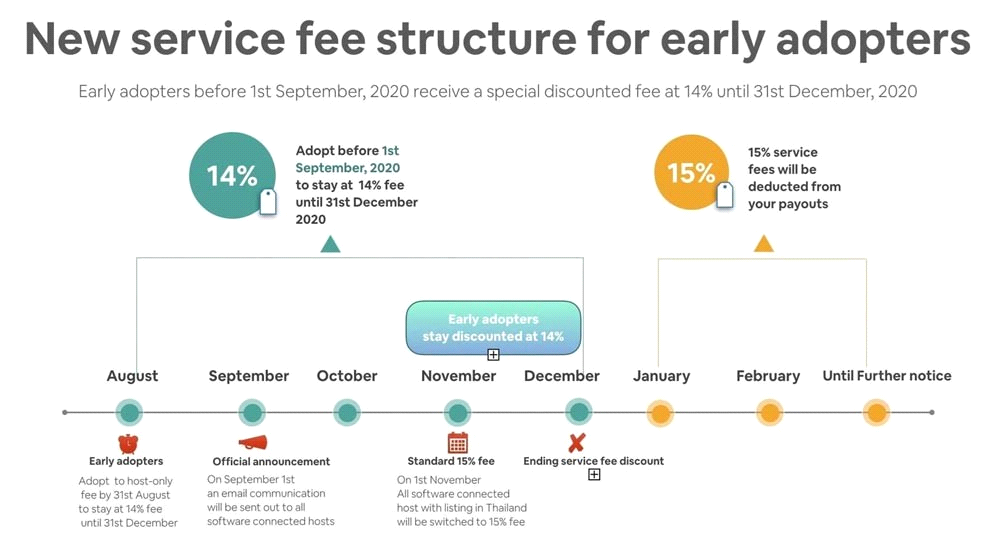
Early adopters could get a discount up until the end of 2020. However, from 2021.01.01. everyone will be obliged to pay the 15% comission Source: https://boostly.co.uk/airbnb-14-percent-commission-changes/#:~:text=The%20standard%20and%20exist
The situation created by the pandemic made companies to come up with alternative solutions in their crisis management. In most of the big cities the unilateral (in rare cases bilateral) regulations are forcing Airbnb to reinvent its main characteristics. Less shared economy; getting more and more alike to other agencies; keeping less and less from the original identity. The image of Airbnb is taking shape in a way that it feautures more and more of the competition.
It is clear that the company tries to meet the expectations of the users with the new regulation; most of them objected to their old method of listing costs such as cleaning, price of the room or comission separated (unlike the competitors). Basically, people react better if they see a sum of the costs– even if the amount is higher because the provider integrates everything in the price.
The effects on the owners’ side are more complex. It will be easier to sync the prices if you use more than one site (most of them have similar comission fees); however, a lot of people have set a higher price on Airbnb already since the cancellations (partially) and especially the assessment of refunds are the site’s competence so as a compensation for the higher risk owners would raise their prices. Even though the extra 12% can be built in the price but different countries have different regulations regarding taxation which could mean additional burdens for the owners. In Hungary, for example, the beneficiary is obliged to pay taxes because of the comission fee of Airbnb which reduces the pool of VAT-free income.
For example, if you want to generate 100.000 Huf income, you would have to advertise your apartment for 115.000 Huf (because of the comission fee). You also have to pay the 27% of the 15.000 Huf as tax which is 4050 Huf. So if you wanted to make 100.000 Huf with a booking, you would reduce your tax-free pool with 119.050 Huf. That basically means the yearly pool of 12 million Huf shrinks to 10 million and that 2 apartments probably won’t fit in that form of taxation.
The way the company is getting closer to their competitors shows that Airbnb tries to aim at the traditional actors of the market as well. Owners providing short-term renting options have already been advertising on the primarily hotel-based sites (booking.com, Expedia, Trviago etc.); hotels, on the other hand, would’nt do the same on Airbnb. However, because of the pandemic, a lot of hotels became interested in other segments of the market too; they are now offering rooms for mid- and long-term also, which creates an overlap big enough for a potential cooperation with Airbnb.
There is a fundamental question regarding the refunds. Advertisers on other sites usually have a bigger control over cash flow; they have a direct access to the fee and they can even ask for a deposit. In case of a cancellation they can just transfer the money back without paying a comission to the site.
Airbnb, on the other hand, has full control over transactions; advertisers are unaware of the card information of the guests and can’t ask for a deposit (although the company’s insurance usually covers any damage that occurs so you could say it’s not necessary). The problem with this one-sided controlling is that Airbnb sometimes doesn’t send the comission fee back to the advertisers in case of a cancellation. With moderate cancellation policy, for example, a cancellation in the last 5 days before the arrival date would mean the owner keeps the full fee of the first night and 50% of the remaining nights, but they wouldn’t get the comission fee back. When it meant a 3% fee it could’ve been counted as „collateral damage” (unexpected cancellations were’nt too common before the pandemic), but 15% could easily lead the owners to choose the reliability o the other sites to lower the risk.
So is it viable for Airbnb to take only parts of a functioning syste, and try to integrate them to his operation? It seems that there would be an inevitable conflict between the advertisers and the site if they implement the new comission fee policy. It could lead the vulnerable owners to turn to other platforms after losing the previously owned benefits. The absence of financial assurances – compared to other sites – could’ve been perceived by many even until now but shared resources may have been a fair compensation. Airbnb may need to let the owners control some elements of the transactions, or change the cancellation and refund policies to give the right answer for the needs of the advertisers and to be able to compete with the benefits offered by other sites.
No Comments