


Over the past decade, one of the most dynamically growing segments in tourism has been the rental of private accommodations in the capital. Airbnb started its journey in Budapest around 2010-11, and by 2016, there were already 4,800 active hosts on the platform. Despite the challenges posed by the COVID pandemic, 7-8 thousand apartments remained active during the restart, and by 2024, 16,000 providers were advertising their accommodations.
Let’s add some nuance: of the 16,000 listings on Airbnb, about 10,000 are active, and according to the Central Statistical Office (KSH), only 7,900; this represents a 28% growth compared to 2023 figures. In the same period, there was no growth in the number of rooms in the 324 commercial accommodations, which totaled 28,000. This shows that the latter group is a consolidated market segment; the discrepancies between supply and demand are marginal, resulting from slow, organic growth.
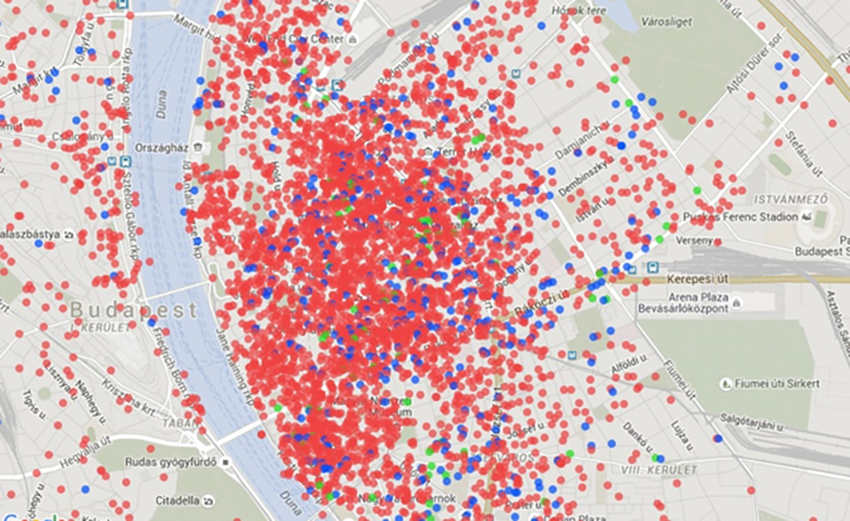
Airbnbs in Budapest in June 2024
The development of private accommodations follows an international pattern: in Florence, for example, there were 6,000 available apartments for tourists in 2016, and by 2023, this number had grown to more than 14,000. This growth is not sustainable indefinitely; in Budapest, by early 2024, the number of beds in private accommodations caught up with those in hotels. Although the overlap between the two guest groups is negligible, this demonstrates the dynamic growth of Airbnb.
In the first half of 2024, the Hungarian Tourism Agency reported record numbers in both the number of guest nights and revenues. However, various forums show that despite this, accommodation providers are reporting declining revenues, which could be due to several factors. On one hand, the increase in the number of available apartments has created intense competition; on the other hand, rental fees have not kept pace with recent inflation. We can assume that the European Football Championship in Germany and the Paris Olympics negatively impacted domestic tourism. In any case, it is evident that the market expansion reflected in KSH statistics does not proportionally match the increase in available accommodations and the rate of inflation.
What conditions can we expect for Airbnb in 2024? Generally speaking, about half of the gross revenue remains as profit for the owner after deducting local taxes, flat-rate tax, passed-on VAT, building tax, utilities, and management fees. In downtown districts, square meter prices already exceed 1 million HUF; properties intended for short-term rental need to be renovated more carefully and to a higher standard than those for long-term rental. Not to mention that the higher risk (it is harder to rent out a property short-term than long-term) no longer necessarily brings higher income under current conditions. Therefore, those considering Airbnb in 2024 face significant investment, high risk, and lower returns than before.
It is worth noting that private accommodation rentals can still be profitable under current conditions, but the property must be special in some way. Sixty-five percent of private accommodations in Budapest are one-bedroom apartments, where competition is the fiercest. However, intermediary platforms favor listings that have been on the platform for a long time (and thus have many reviews) and/or sell many nights. New advertisers face difficulties as they do not start from an equal footing in the competition for bookings.
Is it worth getting into Airbnb in Budapest in 2024? For most, probably not. The imbalance between investment and return, as well as between risk and expected income, is too great for this form of property rental to be profitable for newcomers. Looking back at the 2010s, demand and supply grew in harmony, peaking at the end of 2019. The COVID pandemic caused an immediate collapse in demand, with only the most dedicated hosts staying afloat. After the pandemic, demand surged, but supply couldn’t keep up as quickly, resulting in a record year for those who remained on the market. Due to this and other factors (e.g., lack of attractive alternative investments like government bonds), new market entrants disrupted the balance in 2023, and this process accelerated in 2024. Since private accommodation rental is a fundamentally closed segment (there is little overlap with commercial accommodations; someone who would choose a hotel will not opt for Airbnb instead, and vice versa), new apartments distort the internal market, “sucking the air” from existing accommodations.
Given the current conditions, the profitability ratio between short-term and long-term rentals is narrowing, making medium- and long-term rentals a viable alternative for downtown properties in 2024.
https://www.airdna.co/
https://www.vg.hu/nemzetkozi-
https://www.vg.hu/turizmus/
https://turizmus.com/cikk/
https://www.ksh.hu/
No Comments